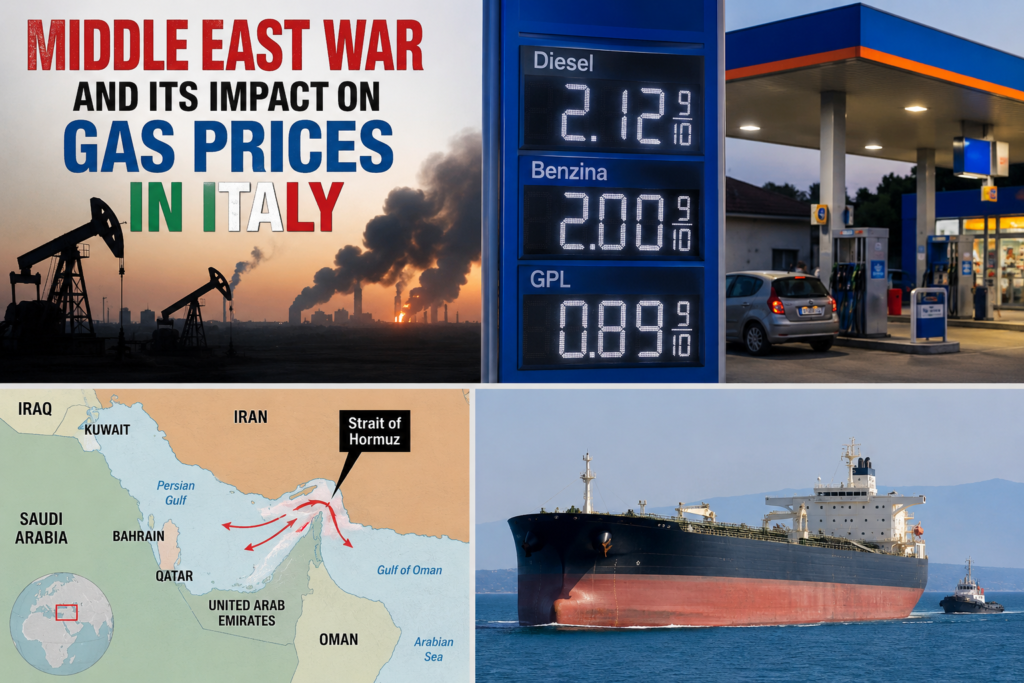
How the Middle East War Is Affecting Fuel Prices in Italy
The conflict in the Middle East is being felt far beyond the region. For people living in Italy, one of the most visible effects is the rising cost of filling up a car.
Fuel prices have been climbing as the war and tensions involving Iran disrupt energy markets and create uncertainty around oil shipments through the Strait of Hormuz, one of the world’s most important energy routes.
For millions of people in Italy who depend on cars for work, shopping and everyday travel, higher fuel prices can quickly become a serious household expense.
Why does a war in the Middle East affect fuel prices in Italy?
Italy does not need to import oil directly from every country involved in the conflict for Italian motorists to feel the consequences.
Oil is traded on a global market. When investors fear that a major supply route could be disrupted, crude oil prices can rise even before a physical shortage reaches Europe.
The Strait of Hormuz is particularly important because large volumes of oil and other energy products normally pass through this narrow waterway between Iran and Oman.
When shipping through the area becomes more difficult or risky, companies can face higher insurance, transport and security costs. Traders also demand a higher price because they are uncertain about future supplies.
These factors can eventually feed into the price consumers pay at Italian petrol stations.
[IMAGE 1 – Strait of Hormuz map]
Petrol and diesel prices in Italy are already above €2 per litre
The effect can be seen at Italian fuel stations.
According to data from Italy’s Ministry of Enterprises and Made in Italy (MIMIT), on August 20, 2026, the national average self-service price on the road network was approximately:
- Petrol: €2.002 per litre
- Diesel: €2.116 per litre
On motorways, the averages were even higher:
- Petrol: €2.077 per litre
- Diesel: €2.186 per litre
These are national averages, so individual petrol stations can be considerably cheaper or more expensive.
For drivers who travel long distances every day, even a small increase per litre can make a noticeable difference to their monthly budget.
What is happening to the price of oil?
The international oil market has reacted strongly to the continuing uncertainty.
On August 20, Brent crude rose to around $93.78 per barrel, while West Texas Intermediate reached around $87.83.
Oil prices do not move only because of the amount of oil currently available. Expectations about future supply are also extremely important.
If traders believe that the conflict could continue disrupting shipments for weeks or months, they may price that risk into oil contracts.
That can keep prices elevated even when the physical supply situation has not completely collapsed.
The Strait of Hormuz is the key concern
The Strait of Hormuz is a narrow waterway connecting the Persian Gulf with the Gulf of Oman.
It is strategically important because enormous quantities of energy products normally pass through it.
During the current conflict, shipping through the area has been significantly disrupted.
[IMAGE 2 – Oil tanker / Strait of Hormuz]
This matters to Europe because Europe participates in the same global energy market.
Even if a tanker carrying oil is not heading directly to Italy, a reduction in available supplies can affect prices internationally.
There is also another problem: ships travelling through a conflict zone can face higher insurance and transportation costs.
Those additional costs can eventually be reflected throughout the energy supply chain.
Why diesel is especially important for Italy
Diesel prices are particularly important for the Italian economy.
Diesel is widely used by private motorists, commercial vehicles, delivery companies, agricultural machinery and other businesses.
When diesel becomes more expensive, the effect can go beyond the petrol station.
A delivery company may have higher transportation costs.
A farmer may pay more for machinery and transport.
A business that receives goods by road may face higher logistics costs.
Eventually, some of these additional expenses can be passed on to consumers through higher prices.
This means that an energy shock can contribute to wider inflation.
What has the Italian government done?
The Italian government has already taken measures aimed at reducing the impact of high fuel prices.
Temporary reductions in diesel excise duties were introduced during the recent fuel-price surge.
However, tax reductions can only partially protect consumers when international oil and refined-fuel prices remain high.
The government therefore faces a difficult balance: providing relief to motorists while also avoiding a large and prolonged cost to public finances.
Will petrol and diesel prices continue rising?
Nobody can predict the exact price of fuel several weeks from now.
There are several factors that could push prices higher:
- A further escalation of the Middle East conflict
- Continued disruption around the Strait of Hormuz
- Lower global oil exports
- Higher shipping and insurance costs
- Reduced refinery capacity
- Further increases in crude oil prices
But prices could also fall if tensions ease, shipping normalises or additional oil supplies reach the market.
This is why motorists should be careful with predictions that fuel prices will definitely reach a particular number.
What can drivers in Italy do?
There are several simple ways motorists can reduce the impact of higher fuel prices.
1. Compare petrol stations
Prices can vary considerably between stations.
Before filling up, drivers can compare nearby prices using Italy’s official fuel-price information service.
2. Use self-service when possible
Self-service is generally cheaper than assisted service.
3. Avoid unnecessary journeys
Combining several errands into one trip can reduce fuel consumption.
4. Drive smoothly
Sudden acceleration and high speeds can increase fuel consumption.
5. Check tyre pressure
Incorrect tyre pressure can increase rolling resistance and fuel consumption.
The bigger picture
The current situation demonstrates how interconnected the global economy has become.
A conflict thousands of kilometres away can influence the price displayed on a petrol station sign in Italy.
Oil prices affect transportation. Transportation affects businesses. Businesses can pass higher costs to consumers.
That is why an energy crisis can eventually become a cost-of-living issue.
For Italian households already dealing with high living costs, the price of petrol and diesel will remain an important issue to watch as the Middle East conflict continues.
Conclusion
The Middle East war is affecting Italy not only through geopolitics but also through the everyday cost of energy.
The disruption and uncertainty surrounding the Strait of Hormuz have contributed to higher oil-market risk, while Italian motorists are already seeing petrol and diesel prices around or above €2 per litre.
Whether prices rise further or begin to fall will depend heavily on what happens next in the Middle East, how quickly energy shipments normalise and how global oil markets respond.
For now, one thing is clear: events in the Middle East can have a direct impact on the daily cost of living in Italy.
Last updated: August 21, 2026
Sources: Italian Ministry of Enterprises and Made in Italy (MIMIT), ANSA, Reuters, Wikimedia Commons.
Pictures for the article
For the featured image, I’d use an Italian petrol station showing fuel prices. For the article body, a Strait of Hormuz map is useful because it explains why a conflict there can affect global energy prices.
You can use the Wikimedia Commons Strait of Hormuz material, which provides licensing information. For example, this shipping/oil map is available under CC BY 4.0, subject to the attribution requirements.
Wikimedia Commons — Oil Deliveries From Hormuz map
Wikimedia Commons — Strait of Hormuz images and maps
For the latest Italian fuel-price figures, the official MIMIT data is the best source.
MIMIT — Italian fuel-price data
SEO suggestion: use the slug
middle-east-war-fuel-prices-italy
and the focus keyword “Middle East war fuel prices Italy”.