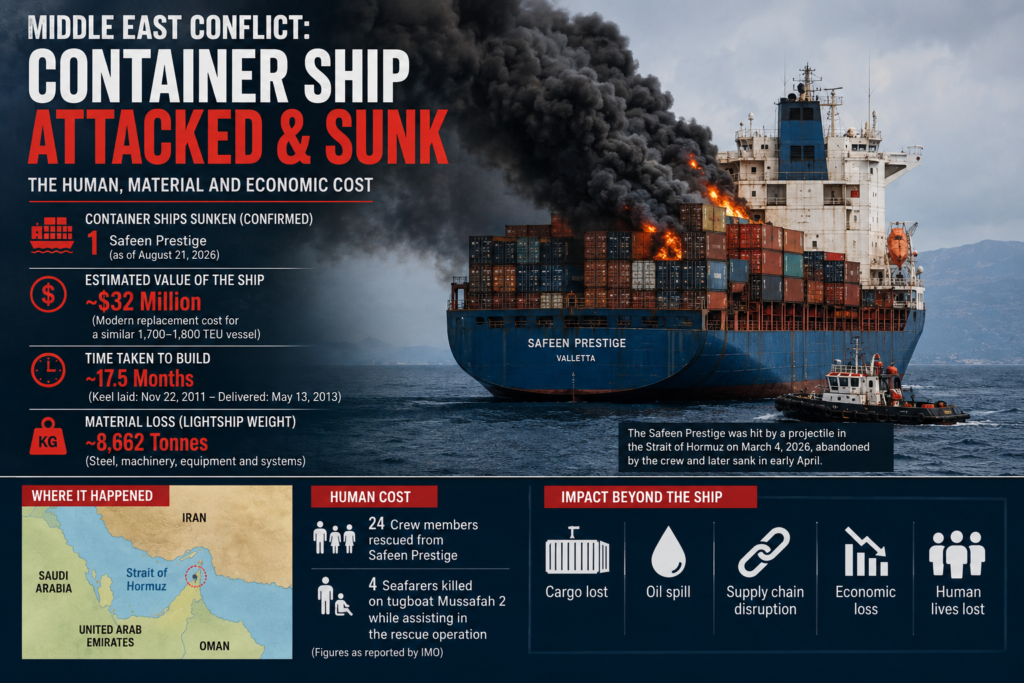
I checked the latest available maritime reporting first. One important correction for accuracy: the evidence does not support saying that many container ships have sunk. As of August 21, 2026, I can verify one container ship—the Safeen Prestige—that was attacked and later sank. Other vessels were attacked or sunk, but they were tankers, bulk carriers, cargo ships or a tug, not container ships.
Here is a WordPress-ready article:
How Many Container Ships Have Been Sunk in the Middle East War?
The war in the Middle East has created a dangerous new threat to commercial shipping. Ships carrying oil, food, manufactured goods and other cargo have come under attack in the Strait of Hormuz, the Red Sea and surrounding waters.
But an important distinction is often missed in reports: not every ship attacked in the conflict is a container ship.
As of August 21, 2026, available maritime reporting identifies one container ship that was attacked and subsequently reported sunk: the Safeen Prestige. Other commercial vessels have been damaged or sunk, but they belong to different categories. (bloomberg.com)
The container ship that was lost: Safeen Prestige
The Safeen Prestige was a Malta-flagged container ship with a capacity of approximately 1,740 TEU — meaning it could theoretically carry about 1,740 twenty-foot-equivalent containers.
The vessel was approximately 175 metres long and had a deadweight of about 23,425 tonnes. It was built in China and delivered in 2013. (Lloyd’s List)
On March 4, 2026, while transiting the Strait of Hormuz near Oman, the ship was hit by a projectile. The impact caused a fire in the engine room, forcing its 24-person crew to abandon the vessel. All crew members were rescued. (Reuters)
The abandoned ship remained in the area for weeks. Satellite and maritime reports later indicated that the vessel sank in the Strait of Hormuz in early April. Pakistan’s hydrographic authorities reported the sinking, while satellite imagery showed the vessel disappearing and an oil sheen remaining in the area. (bloomberg.com)
How much was the ship worth?
The exact construction price paid for the Safeen Prestige has not been publicly established, so it would be misleading to claim a precise dollar value for the vessel.
However, we can use modern ships of a similar size as a replacement benchmark.
In 2026, Euroseas ordered 1,800-TEU container ships for approximately $32.26 million each. (Seatrade Maritime News)
That gives us a useful indication:
Approximate modern replacement benchmark: $32 million per ship
But this should not be presented as the actual value of the Safeen Prestige. The vessel was built in 2013 and was already about 13 years old when it was lost.
How long did it take to build?
The construction history of the Safeen Prestige provides an interesting picture of how much time goes into producing a large commercial vessel.
The ship’s keel was laid on November 22, 2011.
It was delivered on May 13, 2013.
That means the construction period from keel laying to delivery was approximately 17½ months. (Fleet Photo)
So a vessel that took well over a year to design, construct, equip and commission was ultimately lost after a single attack and weeks of subsequent fire and abandonment.
How much material was lost?
The Safeen Prestige had a lightweight of approximately 8,662 tonnes.
Lightweight, or lightship displacement, is the weight of the ship itself without its cargo, fuel and other variable loads. It includes the hull, machinery, equipment and other permanent components. (Compass Maritime Services)
It is important not to describe all 8,662 tonnes as steel because the figure includes machinery and other materials.
The ship also had:
- 1,740 TEU container capacity
- Approximately 23,425 tonnes deadweight
- Approximately 18,252 gross tonnage
- Approximately 175 metres length
- Approximately 27 metres beam (MagicPort)
The exact quantity and monetary value of cargo lost with the vessel has not been publicly established.
A maritime publication reported that the vessel burned extensively and that its cargo was destroyed. (Marhisdata)
That means the total economic loss was greater than the value of the ship itself.
Were any civilians killed on the Safeen Prestige?
No deaths were reported among the Safeen Prestige’s crew.
All 24 crew members were rescued after the attack. (IFC IOR)
However, the attempt to assist the abandoned container ship resulted in another tragedy.
The rescue tug that was sunk
Two days after the Safeen Prestige was attacked, the tug Mussafah 2 was sent to assist the damaged container ship.
On March 6, the tug was struck by projectiles while attempting to help.
The International Maritime Organization’s casualty information recorded four seafarer fatalities and three serious injuries in the incident. Other reporting recorded discrepancies in the casualty figures, including missing crew members, so the exact final human toll has been reported differently by different sources. (Airwars)
The important point is that Mussafah 2 was a tugboat, not a container ship.
Therefore, it should not be counted when calculating the number of container ships sunk.
What about other ships?
Several other commercial vessels have been attacked during the conflict.
These include:
- Tankers
- Bulk carriers
- Cargo ships
- Tugboats
- Container ships
For example, the Tihamah, a small multipurpose cargo vessel, was attacked in the Bab el-Mandeb Strait in August 2026. Six people — four crew members and two rescuers — were reported killed. However, it was not a container ship. (International Maritime Organization)
A separate Panama-flagged container ship, the Vela Nova, was reportedly hit and disabled in August, but available reporting does not establish that it sank. (Reuters)
Another container vessel, Source Blessing, operated by Hapag-Lloyd, was hit by projectile fragments near the Strait of Hormuz in March. The available report did not indicate that it sank. (Reuters)
This distinction is important because headlines about “ships attacked” can easily be mistaken for “ships sunk.”
The real cost goes beyond the ship
The financial damage from a maritime attack cannot be measured only by the price of the vessel.
There can be losses from:
1. The ship itself
A modern feeder container ship of around 1,800 TEU can cost more than $30 million to build today. (Seatrade Maritime News)
2. Cargo
Thousands of tonnes of goods can be carried aboard a container ship. If the vessel is destroyed, cargo owners, insurers and shipping companies can all suffer losses.
3. Containers
The containers themselves can also be lost or damaged.
4. Fuel and machinery
Engine rooms, generators, navigation equipment, cranes and other machinery can be destroyed by fire or missile damage.
5. Salvage
Recovering a damaged ship from a war zone is extremely expensive and dangerous.
6. Environmental damage
A sinking ship can release fuel, lubricants and other pollutants into the sea. Reports following the loss of the Safeen Prestige indicated an oil sheen in the area. (bloomberg.com)
7. Human lives
The greatest loss cannot be measured in dollars. Seafarers and rescue workers are civilians who work aboard commercial vessels, not combatants.
Why container ships matter to ordinary people
The destruction of a single ship may appear insignificant compared with the size of the global shipping industry.
But repeated attacks can have a much bigger effect.
Shipping companies may avoid dangerous routes.
Ships may take longer alternative routes.
Insurance premiums can rise.
Fuel consumption can increase.
Delivery times can become longer.
Cargo rates can rise.
Eventually, these additional costs can reach consumers.
That can mean higher prices for everything from electronics and clothing to food and household products.
The bigger problem: shipping routes are being disrupted
The Strait of Hormuz is one of the world’s most strategically important maritime passages.
Before the conflict, very large numbers of commercial vessels passed through the region.
By August 21, Reuters reported that only seven commodity ships had navigated the Strait of Hormuz on the previous day. No large crude carriers or LNG tankers were recorded among those crossings. (Reuters)
That dramatic reduction in traffic shows why the economic consequences of the conflict extend far beyond the countries directly involved.
A tragedy measured in ships, cargo and human lives
The story of the Safeen Prestige demonstrates the enormous resources invested in global shipping.
A vessel approximately 175 metres long, capable of carrying around 1,740 containers, required roughly 17½ months to build.
It represented millions of dollars of investment and thousands of tonnes of physical materials.
Yet it was ultimately abandoned after an attack and later sank.
The loss of the ship was serious, but the human consequences are even more important.
The Safeen Prestige itself had no reported crew deaths. However, the rescue operation that followed led to the deaths of seafarers aboard the Mussafah 2.
These incidents demonstrate the increasingly dangerous conditions faced by civilian merchant crews working in conflict-affected waters.
How many container ships have actually sunk?
As of August 21, 2026:
Confirmed/reported container ship losses
1 — Safeen Prestige
- Type: Container ship
- Capacity: approximately 1,740 TEU
- Built: 2013
- Builder: Guangzhou Wenchong Shipyard, China
- Length: approximately 175 metres
- Deadweight: approximately 23,425 tonnes
- Crew: 24
- Crew deaths aboard the ship: 0
- Construction period: approximately 17½ months
- Lightweight: approximately 8,662 tonnes
- Reported fate: sank in the Strait of Hormuz
- Modern replacement benchmark: approximately $32 million for a similar-size newbuild
The $32 million figure is a replacement benchmark, not the historical purchase price of the Safeen Prestige.
Conclusion
The Middle East war has created an increasingly dangerous environment for commercial shipping.
However, it is important to separate container ships from other types of vessels when discussing maritime losses.
As of August 21, 2026, the evidence available publicly supports one container ship — Safeen Prestige — as having been lost by sinking during the conflict.
Other ships have been attacked, damaged or sunk, including tankers, bulk carriers, cargo vessels and the Mussafah 2 tug.
Behind every ship is a huge amount of steel, machinery, fuel, cargo, money and human work.
And behind every crew member are families waiting for them to return home.
The growing attacks on commercial shipping therefore represent not only an economic problem, but also a serious humanitarian and global trade problem.
This article should be updated as new maritime incidents are independently confirmed